

THE HIDDEN HEALTH COST OF WHAT WE WEAR
By Clementina Martinez-Masarweh “The Sustainable Latina”
In the quiet corners of college labs and under the lens of a microscope, I’ve uncovered an alarming truth: the fashion industry is not just a climate crisis contributor - it’s a public health hazard. My journey exploring how microplastics from textiles affect human health has led to unique collaborations with students and faculty across U.S. campuses. I’ve seen firsthand how fashion’s toxic trail winds its way into our oceans, our bodies, and even our DNA.
As a quantum physics geek and lifelong science lover passionate about health and the environment, I launched DNA Sustainable Threads - a name that combines my passions and my kids’ initials. Fashion has always pulled me in, and though I once worked in fast fashion, I’ve been advocating for slow fashion for the past 13 years. I now find myself in the right place, with the right information, at the right time.
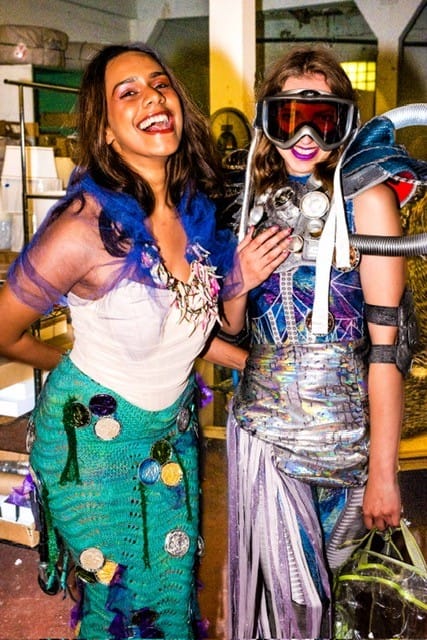
My deep dive into plastic and its relationship to fashion took a darker turn after reading a 2020 article in The Guardian, “Microplastics revealed in the placentas of unborn babies.” The quote that stopped me cold: “It’s like having a cyborg baby: no longer composed of human cells, but a mixture of biological and inorganic entities.” That was the lightbulb moment. I began designing my own “cyborgs” out of post-consumer waste - plastic, e-waste, textiles, discarded sports equipment, and other landfill debris. I didn’t yet know their purpose, but I knew the world needed to learn about the hidden harms of plastic. Since then, I’ve brought these creations to galleries in San Francisco and Pennsylvania, runways in Chicago, and now to the screen - through a short film currently in production with LA-based director Mariel Noir.
A Toxic Wardrobe
Plastic in fashion hides in plain sight. From glittery trims and waterproof coatings to elastic waistbands, our clothes are filled with synthetic materials and toxic additives like BPA, phthalates, and PFAS - so-called “forever chemicals” that persist in our bodies and the environment.
These substances don’t just contaminate water and air. They accumulate in human tissue, disrupt hormones, and are linked to reproductive issues, cancers, and neurodevelopmental delays. Our skin - the body’s largest organ - is exposed daily.
One of the most sobering findings comes from Dr. Shanna Swan, environmental epidemiologist at Mount Sinai and author of Count Down. Her research reveals a 50% global decline in sperm count over the past 40 years, largely due to endocrine-disrupting chemicals in plastics, including those in fashion. If trends continue, sperm count could reach zero by 2045. Natural reproduction would be nearly impossible. And fashion, once again, is part of the problem.
The Invisible Invader: Microplastics and Nanoplastics
In 2024, a moment that forever shifted my understanding of textiles and microplastics happened at Lafayette College’s Sustainability Department in Pennsylvania. Working with Samantha Smith and the science team, we examined microplastics and microfibers under microscopes. As part of a senior thesis, a student was researching microplastic ingestion in local bird populations - and discovered something deeply troubling: 100% of the birds studied had microplastic particles embedded in their bodies.
But the source wasn’t plastic bags or bottle caps. It was clothing.
During that collaboration, I also showcased my “trashion” cyborg designs alongside Barbara Kavchok’s art exhibit ReFash: A Futuristic Intersection of Style, Sustainability and Consumption at the Banana Factory in Bethlehem. Artists and designers from around the world contributed, spotlighting the devastating effects of fast fashion - from overproduction to toxic plastic waste. It was a truly remarkable and affirming experience to be a part of.
Through my education work, I’ve also taught students to examine fabric under microscopes. What looks like soft fleece reveals itself as a tangled web of synthetic polymer fibers - shedding constantly with wear and washing. Laundry wastewater is now one of the main sources of microplastics in our freshwater systems. Even treatment plants can’t fully filter out the smaller nanoplastics, which are now showing up in human lungs, placenta, breast milk, and blood.
Early research suggests these particles can cross the blood-brain barrier, disrupt cellular function, and trigger immune responses. And we wear this risk daily. We gift it to our children in soft pajamas. We jog in it. We donate it, thinking we’re helping - only for it to pollute another corner of the planet.
Fashion’s Chemical Legacy
This exposure isn’t limited to consumers. Garment workers - most of them women in the Global South - face toxic conditions during production, often inhaling or touching dyes, flame retardants, and plasticizers. This is an urgent environmental justice issue.
When I speak to young people about textile waste and sustainable solutions, I always highlight how interconnected the crisis is. The microfibers from our leggings don’t stay with us - they travel, they accumulate, and they damage ecosystems. Yet fast fashion continues to market these items as “eco-friendly” or “essentials.”
A New Story for the Future: Cyborg Human
That interconnection inspired my short film, Cyborg Human: The Future We Chose, currently in pre-production. The experimental film imagines a future where nanoplastics alter our biology, and humanity becomes a hybrid of organic and synthetic life. We don’t just wear plastic - we become it.
Debuting at NYC Climate Week 2025, Cyborg Human blends art, science, and fashion with original costumes made from real post-consumer waste. It asks: What happens when survival - not style - drives what we wear? Through sound, visuals, and movement, the film conveys what scientific data alone cannot: urgency, emotion, and possibility.
Reimagining Fashion Through Health
As a designer, filmmaker, and social impact strategist, I can’t unsee what I’ve learned. I’ve heard scientists describe analyzing lung tissue coated in airborne fibers. I’ve worked with students, shocked by what they find in local wildlife. It all confirms one truth: our closets are toxic.
But knowledge must lead to transformation.
At climate events in LA, SF, and beyond - including Women in Clean Tech & Sustainability - I’ve been advocating for circular systems, compostable textiles, non-toxic dyes, and the end of fossil-fuel-based fabrics. I’ve mentored students researching biodegradable alternatives and collaborated with scientists developing wearable fabrics from algae, fungi, and cellulose. These aren’t future concepts - they’re happening now.
Fashion can be regenerative - but only if we are willing to change everything about how it’s made.
What You Can Do
Start by reading labels. Avoid polyester, nylon, acrylic, and blends. If you already own synthetics—as I do—wash them sparingly, use cold water, and spot clean to reduce shedding. Install a microplastic filter or use a Guppyfriend bag.
Choose organic fabrics like hemp, linen, or cotton—being mindful of chemical treatments and water use. Support brands committed to non-toxic processing, biodegradable materials, and circular models.
And most importantly, demand more from your wardrobe. Ask your clothes to be ethical. To be safe. To stop harming you.
We’re standing at a crossroads. Every garment we wear is a vote. Cyborg Human is a warning —but also an invitation. Let’s choose better.
Let’s break up with plastic, for good.